Muccassassina — 8 Years Inside Rome's Circle of Lust and Vanity
I didn't choose Muccassassina. Muccassassina chose me.
It was 2017. A colleague couldn't make it and I was asked to step in. I remember standing outside Qube — one of Rome's largest clubs — genuinely nervous. I knew what the place was. I didn't know if I was ready for it.
Inside, everything was black. Black walls, black ceiling, three floors of controlled chaos. When I fired my flash, the darkness swallowed the light whole. Every rule I knew about photography — keep your ISO low, protect your image quality — became useless within the first hour. Underground nightlife has its own physics. You either learn them fast or you go home with nothing.
Then came the drag queens.
Nobody warned me how demanding they are. Not in a bad way — in the best possible way. They know exactly what they want from a frame. They've worked on their look for hours. They expect you to see it. Those first nights taught me more about portrait photography than years of formal events ever had.
The School I Didn't Know I Was Attending
I kept going back. Every Friday at first, then every major party, then — as the years passed and life got more complex — once every couple of months for the most exclusive nights. Eight years. Hundreds of parties. Thousands of frames.
What Muccassassina did to my photography is hard to explain rationally. When I started, I was shooting private events — clean, predictable, polite. After a few years inside Qube, my whole visual language shifted. The color came in. The grain came in. The willingness to get close, to stay in the chaos, to trust the imperfect frame — all of that came from those Friday nights.
The place itself is overwhelming in the best sense. Three floors. Endless crowds. Dante's own circle of lust and vanity — if Dante had a great lighting rig and a DJ. You see people you couldn't invent — costumes, bodies, expressions, encounters. About half the crowd is queer, half straight. Young people who are there for one reason: to enjoy themselves completely. Very few fights. A lot of joy. A lot of freedom.
Muccassassina is the place where expressive freedom has no ceiling. Where your strangest self is also your most welcome self.
The Technical Reality of Shooting in the Dark
Over the years I moved entirely to Sony mirrorless — specifically for their high-ISO performance. Modern sensors can pull extraordinary detail from near-darkness, but the camera is only part of the equation. The other part is glass.
My standard for event reportage is a 24mm f/1.4. In a crowd, it's the perfect focal length — wide enough to feel immersive, fast enough to work in near-darkness, close enough to feel intimate without being intrusive. You're in the scene, not observing it from outside.
The one technical hazard nobody tells you about: lasers.
In eight years, I've burned through two camera sensors. Mirrorless cameras are particularly vulnerable — the laser hits the sensor directly and kills pixels permanently. You don't realize it happened until you're reviewing your shots at 3am and find a dead stripe running through your best frames of the night. It's the occupational hazard nobody puts in the photography manuals.
The Studio Sessions: Where the Real Magic Happens
The club is electric. But the sessions I treasure most are the studio days with the performers.
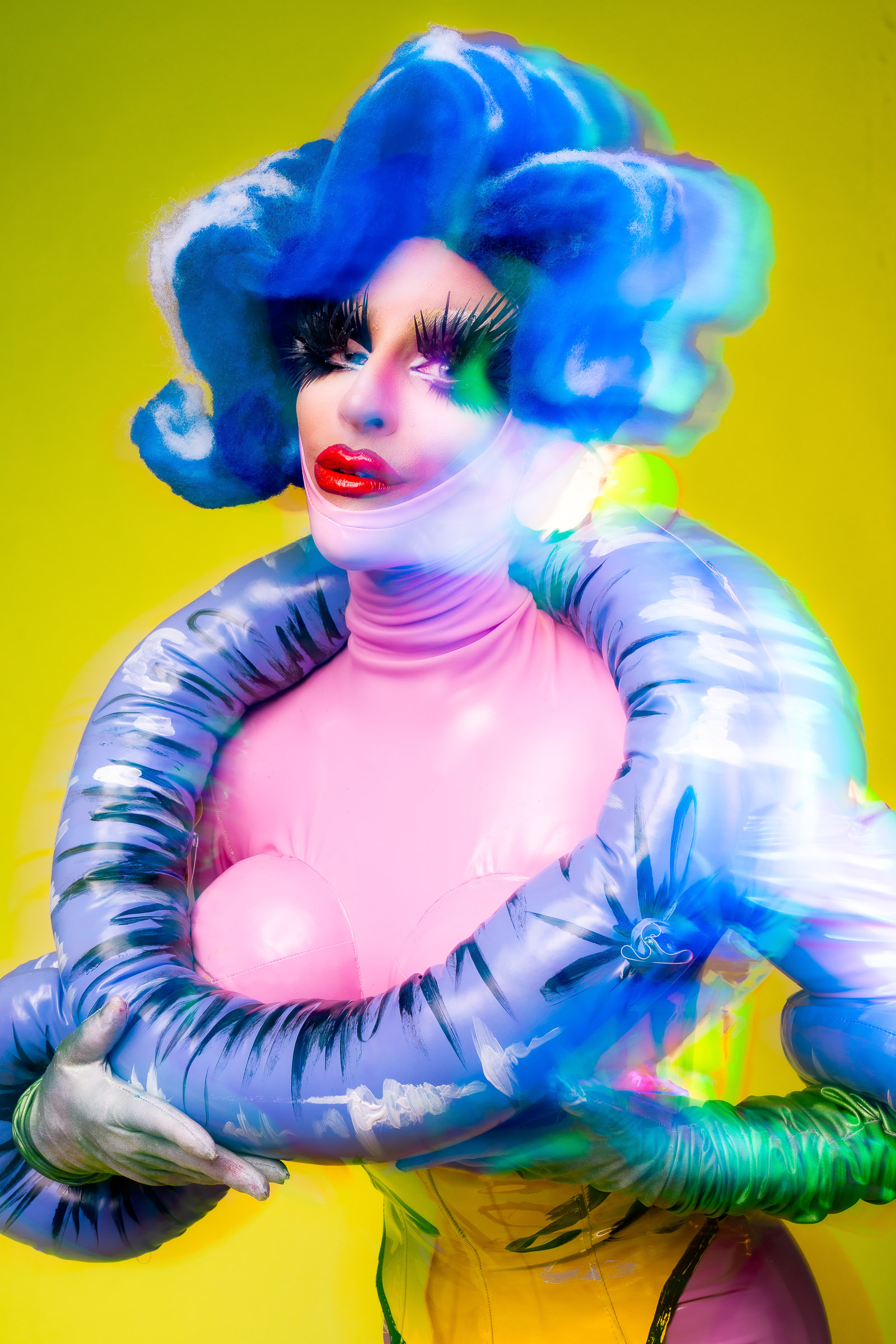
When a drag queen comes to my studio — no crowd, no noise, no time pressure — everything changes. They give you everything. All the energy that normally explodes across a dancefloor gets focused into a single frame. My favorite portrait from those eight years was shot in studio, not at the club: Farida Kant, acid green background, pink latex suit. The image is vivid, strange, and completely hers. That's the photograph I keep coming back to.
On Honesty and Movement
I have a confession about my shooting method.
When I'm on stage photographing performers, I sometimes tell them I'm shooting video instead of photos. It's a small lie with a very specific purpose: the moment people think a camera is rolling, they move differently. They stop posing. They perform. And performance — real, physical, unselfconscious performance — is what I want to capture.
I'm not interested in the composed shot. I want to feel the energy in the frame. I want the image to move even when it's still.
I also never steal frames. In eight years at Muccassassina, I've never had a serious confrontation about privacy — because I don't take photos people don't want taken. I approach. I make eye contact. Most of the time they want the photo more than I do.
What Eight Years Taught Me
Three words for Muccassassina: bold, Dante's inferno, color. Three words for what it gave my photography: the same three words.
The underground doesn't follow rules. Neither should the photographer documenting it.